

“For thou art soil, and to the soil shalt thou return.”
Course number: 2024-1-LV01-KA131-HED-000206171-2
The person responsible for signing the Online Learning Agreement: Kaspars Kampuss, e-mail address: kaspars.kampuss@lbtu.lv
Administrative contact: Zinaida Jursevska, email address: zinaida.jursevska@lbtu.lv
Organizer contact: Ieva Erdberga, email address: ieva.erdberga@lbtu.lv
Field: Soil science, geology, land use
BIP Objectives:
To raise theoretical and practical qualifications and skills of students and young researchers. We expect a significant increase of both hard and soft competences of students. Students will learn to describe and classify soils and how to interpret it in terms of their ecological value, sustainable use and protection of soil resources. Students will be instructed how to lead scientific discussion when giving and/or receiving feedback and how to evaluate and judge effects of others work.
Target group:
Target groups are students (all levels) of environmental related programmes (geography, earth sciences, environmental protection, agriculture, forestry etc.) from partner institutions (direct beneficiaries) and academicians and students from other EU and non-EU universities (beneficiaries participating on their own expenses).
After completing the training, the student:
- critically thinks about the role of soil in the landscape, ecology and the impact of soil on the economic and social aspects of human life;
- knows the composition of soil and its properties,
- understands soil forming factors and processes and explains the morphological structure of soil (horizons, profile);
- interprets soils from classification point of view;
- systematically thinks about soil within different classification systems;
- recognizes a certain type / reference group according to the pictorial material and in the field, names it correctly and places it in the classification system;
- is able to perform independent field work in the field of soil.
Course Methods are:
- lectures;
- on-line discussions in mixed international groups;
- evaluation on the base of on-line test;
- fieldwork;
- use of ICT;
- use of direct observation methods;
- cooperative learning;
- experiential learning;
- case studies;
- field research methods and techniques in physical geography.
The course will be delivered by teachers from:
- Nicolaus Copernicus University (Toruń, Poland),
- University of Ljubljana (Ljubljana, Slovenia),
- Estonian University of Life Sciences (Tartu, Estonia),
- Poznań University of Life Sciences, Poland.
- Technical University, Braunschweig, Germany.
- Technological College of Huesca,University of Zaragoza, Zaragoza, Spain
- Vytautas Magnus University, Lithuania.
- Martin Luther University (Halle-Wittenberg, Germany).
Language: English
Price: No tuition fee
ECTS credits: 3
Additional expenses: Participants cover their accommodation costs, part of the meals and transportation costs to and from the workshop.
- Part 1: Virtual Mobility
1st –20th June 2026.
The online component of the course will be hosted via Zoom application, the collaborative online learning platform of the University of Life Sciences and Technologies. Participants need to have a stable internet connection, a computer, a headset, and a webcam. Sessions will be held (recorded lectures) and synchronously (exercises) in the CEST time zone.
Online Implementation – 12 hours of lectures from
- 12 hours of lectures
- 30 hours of independent study
Topics:
- Physical Geography of Latvia;
- Introduction to WRB as a Lingua Franca;
- Diagnostic Features – Structure, Accumulation of Substances;
- Redoximorphic Features;
- Diagnostic Horizons;
- Diagnostic Properties and Materials;
- Reference Soil Groups (RSGs);
- Qualifiers and Soil Naming;
- Field Methods for Soil Classification.
- Part 2: In-Person Mobility
29th June -3rd July, 2026
Preliminary schedule:
Sunday, June 28:
- Arrival in Latvia, Jelgava and accommodation.
Monday, June 29:
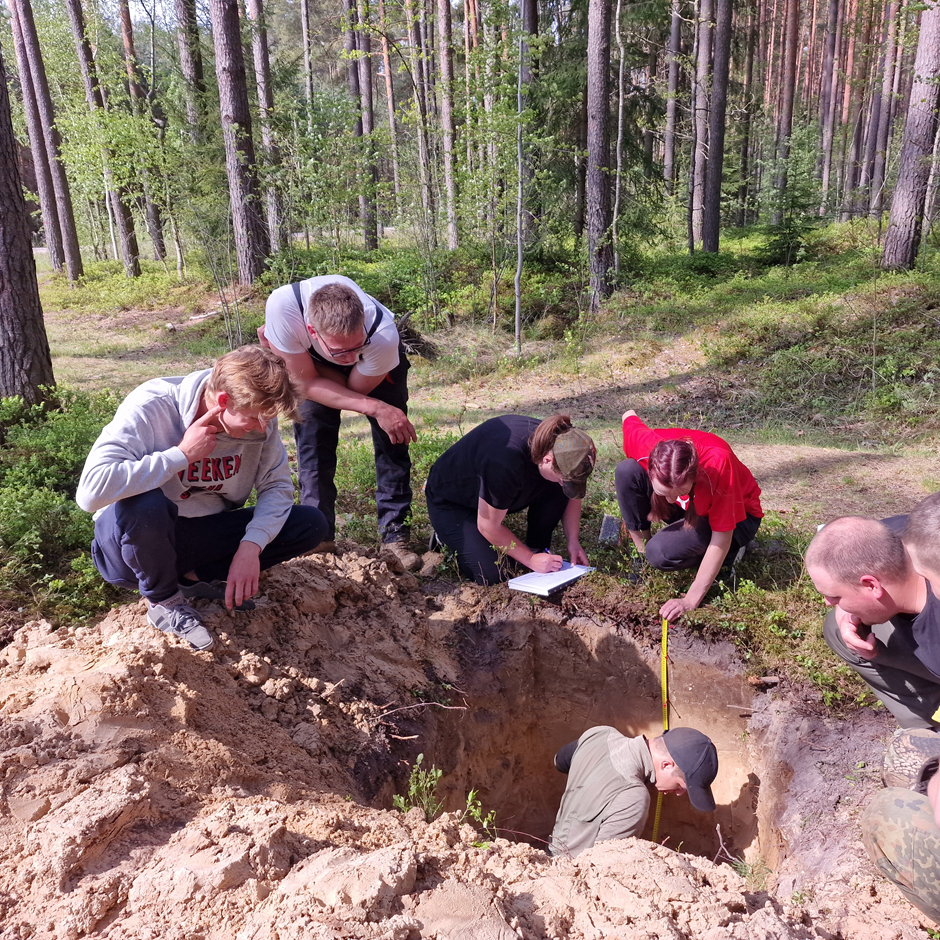
- Introductory meeting, formation of working groups, and preparation for fieldwork (1 hour);
- Fieldwork at selected locations in forest plantations near Jelgava (7 hours);
- Meet-and-greet evening and group socializing.
Tuesday, June 30:
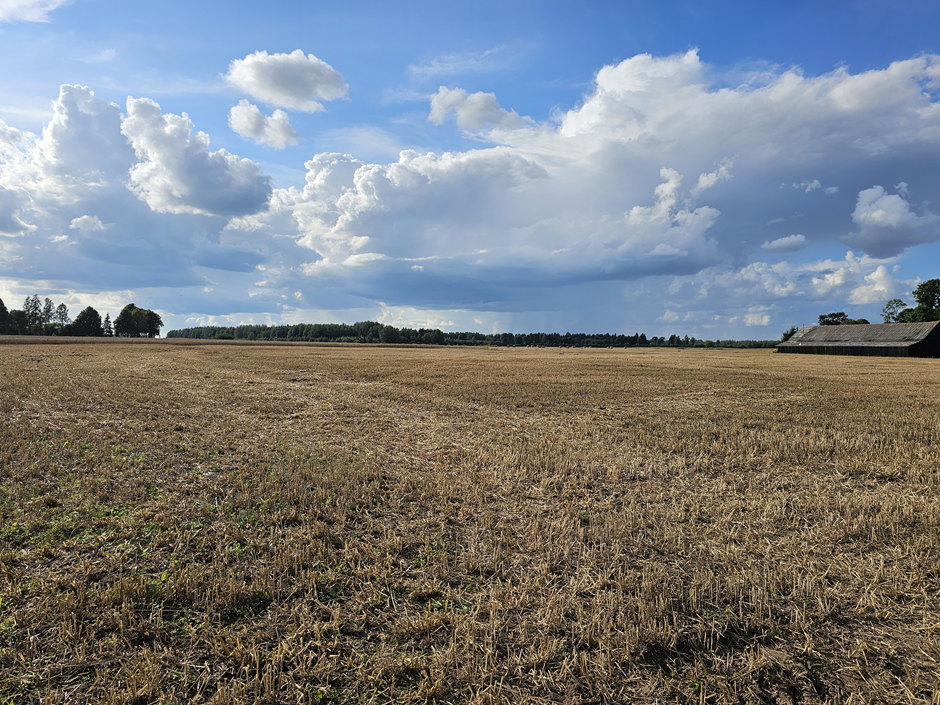
- Full-day fieldwork at selected locations in South Courland (8 hours).
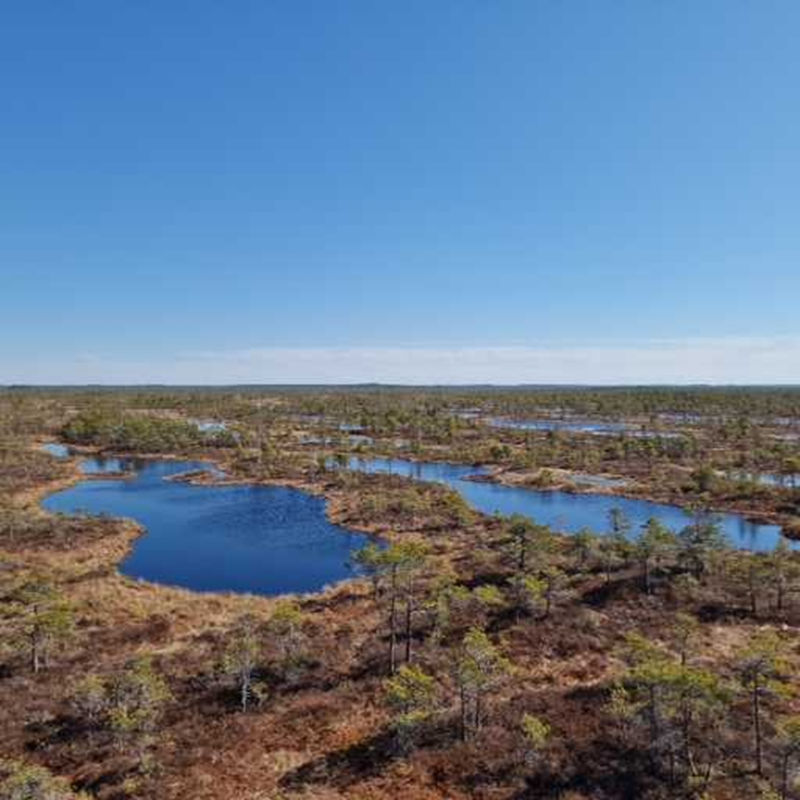
- Visit at Great Ķemeri Bog Boardwalk.
Wednesday, July 1:
- Full-day fieldwork at selected locations near Kuldīga (Central Courland) (8 hours);
- Visit at Sand Caves of Riežupe.
Thursday, July 2:
- Full-day fieldwork at selected locations near Jūrkalne (Northwest Courland) (8 hours);
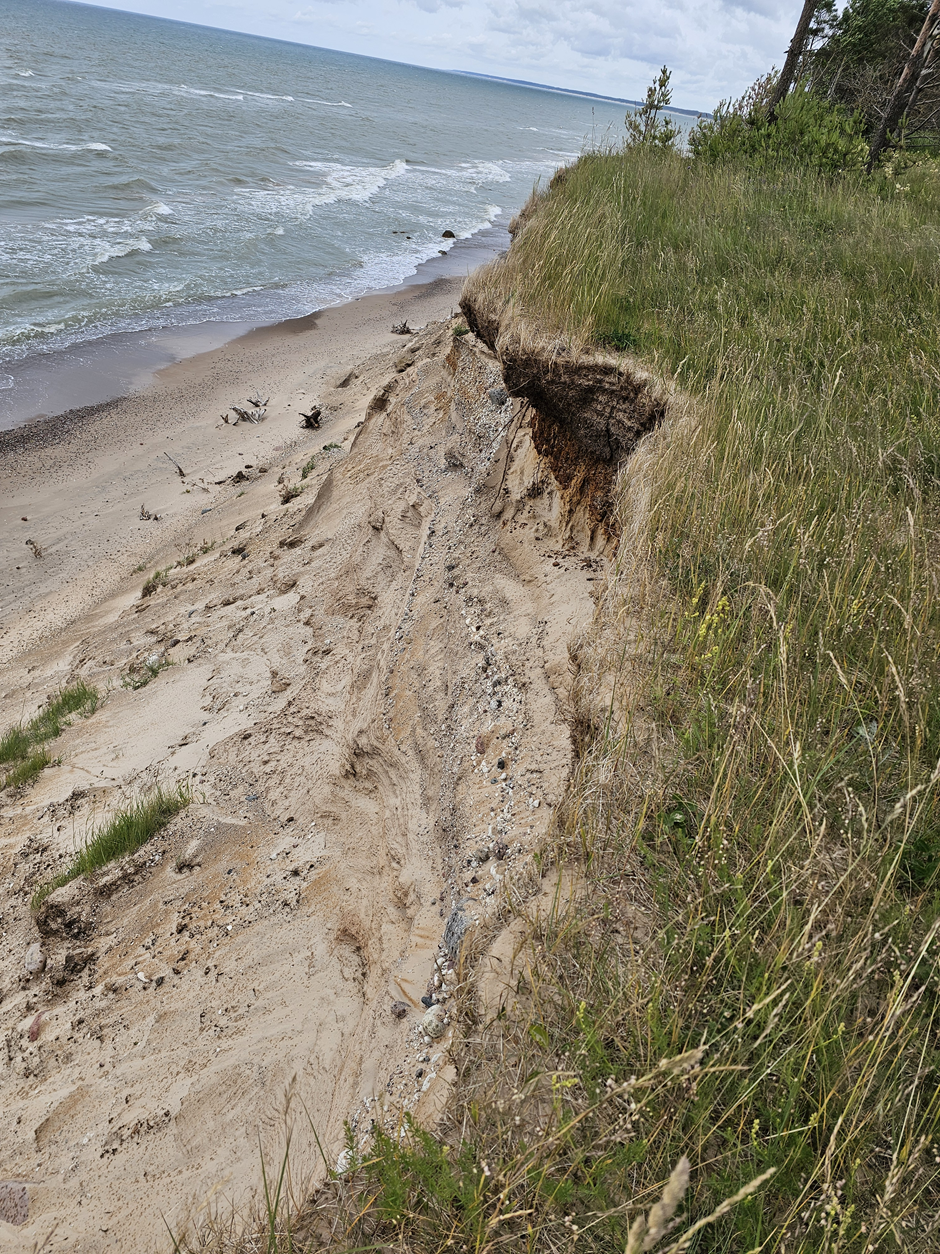
- Visit at Jūrkalne steep bank.
Friday, July 3:
- Summary of fieldwork findings (1 hour);
- Report preparation, presentation creation, and group discussion (3 hours);
- Presentation of findings (1 hour);
- Discussion of findings among groups (1 hour);
- Conclusions, awards and participation certificates;
- Visit at Gulf of Riga (East Courland) and farewell bonfire party.
Saturday, July 4:
- Departure home.
- Partners universities
- Coordinator: Latvia University of Life Sciences and Technologies, Jelgava, Latvia.
- University of Ljubljana, Ljubljana, Slovenia.
- Nicolaus Copernicus University, Toruń, Poland.
- Estonian University of Life Sciences, Tartu, Estonia.
- Poznań University of Life Sciences, Poland.
- Technological College of Huesca, University of Zaragoza, Zaragoza, Spain
- Technical University, Braunschweig, Germany.
- Vytautas Magnus University, Lithuania.
- Martin Luther University, Halle-Wittenberg, Germany.